Our video monkeys are carefully fetching this clip for you...
Blizzard vs. Snowstorm: What's the Difference?
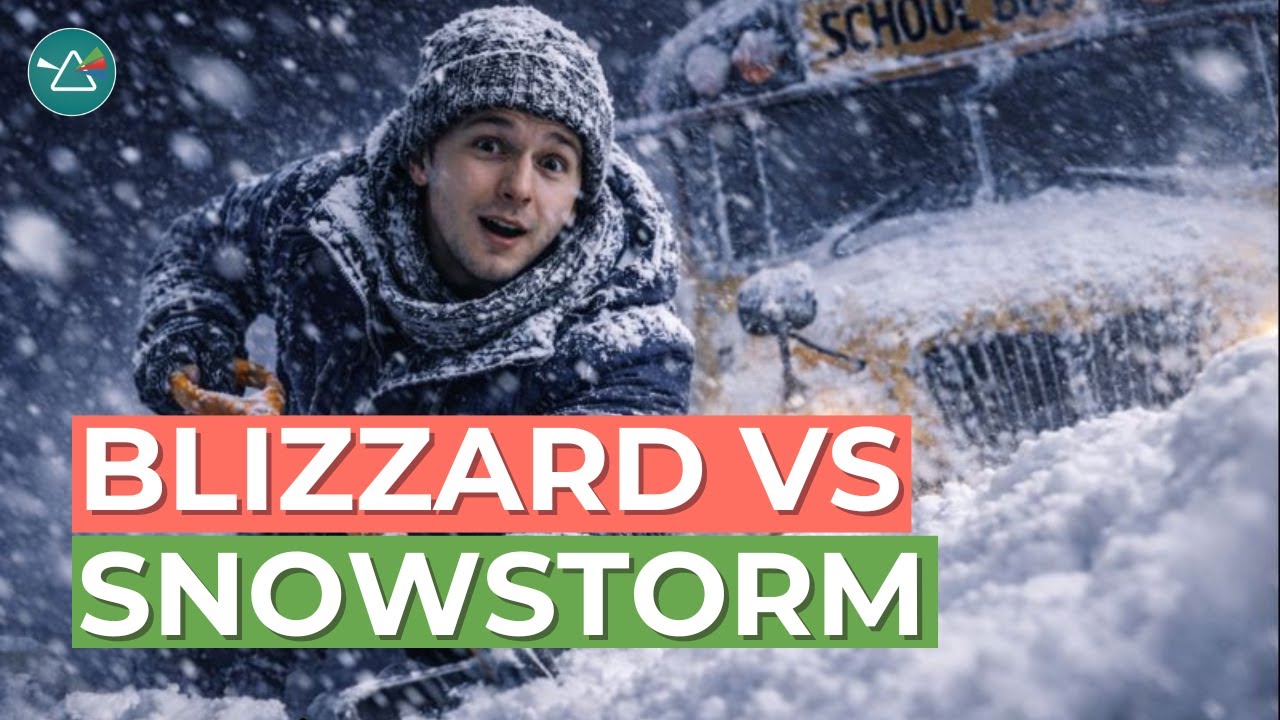
Is it just a snowstorm, or is it a true blizzard? This Grade 3-5 science lesson breaks down the extreme weather definition students need to know.
What students will learn
The 3 specific conditions required for a storm to be a "Blizzard"
The official National Weather Service definition (Wind speed, duration, and visibility)
How warm and cold air fronts collide to create extreme weather
The real-world economic impact of blizzards on communities
Summary
In this live-action science program, students answer the question "What is a blizzard?" and explore the dangerous science behind this severe winter storm. We break down the National Weather Service criteria: winds exceeding 35 mph, visibility less than ¼ mile, and a duration of 3+ hours. Viewers will visually identify the three key ingredients for formation: moisture, a collision of warm and cold air, and below-freezing temperatures. The lesson also covers blizzard facts regarding long-term effects, including economic loss and infrastructure damage. Ideal for Grade 3-5 science units on weather hazards and NGSS 3-ESS3-1.
Teacher & Parent Value
Aligned with NGSS standards for Earth Systems and Natural Hazards. Perfect for introducing weather units or explaining current events to students.
Usage Tip: Use this video as a warm-up before a hands-on "design a blizzard-proof school" STEM challenge.
Subscribe for more "Curriculum for Curious Minds" and discover our complete science unit here: https://bit.ly/4sjvvql
TIMESTAMPS
00:00 What Is A Blizzard?
00:45 Snowstorm vs. Blizzard
01:30 The 3 Ingredients for Formation
02:15 Warm & Cold Air Fronts
03:00 Official NWS Definition
03:45 35 MPH Winds & Visibility
04:30 Economic Impact & Damage
05:15 Staying Safe in Winter Weather
EDUCATIONAL STANDARDS
NGSS Candidates (3–5)
3-ESS3-1 (Earth and Human Activity)
Description: Make a claim about the merit of a design solution that reduces the impacts of a weather-related hazard.
Confidence: 95%
Evidence: The video establishes the hazard (blizzard) and its impacts (economic/infrastructure), setting the stage for design solutions.
ESS3.B (Natural Hazards)
Description: A variety of natural hazards result from natural processes. Humans cannot eliminate natural hazards but can take steps to reduce their impacts.
Confidence: 90%
Evidence: Direct alignment with the video's focus on definition and impact.
3-ESS2-1 (Weather and Climate)
Description: Represent data in tables and graphical displays to describe typical weather conditions expected during a particular season.
Confidence: 80%
Evidence: Defines specific weather data points (wind speed, temp) typical of winter.
CCSS Candidates
RI.3.1 / RI.4.1 (Key Ideas & Details)
Description: Ask and answer questions to demonstrate understanding of a text, referring explicitly to the text as the basis for the answers.
Confidence: 85%
Evidence: The video provides explicit answers to "what is a blizzard" for students to cite.
RI.3.4 (Vocabulary)
Description: Determine the meaning of general academic and domain-specific words and phrases in a text.
Confidence: 80%
Evidence: Focus on domain terms like "visibility," "infrastructure," and "precipitation."
Best-Fit Alignment Summary
This video best aligns with NGSS 3-ESS3-1 by defining blizzards as a specific weather hazard, providing the necessary scientific context for students to subsequently design solutions for reducing their impactIs it just a snowstorm, or is it a true blizzard? This Grade 3-5 science lesson breaks down the extreme weather definition students need to know.
a
arielle kleinon November 2nd, 20260 views

Now it’s your turn!
Join thousands of educators and professionals who use SafeShare to share knowledge.